
Confession
A Rosh Hashanah poem (and some thoughts from "Zen Rabbi" Alan Lew)

Shana Tova! This week we celebrate the Jewish new year, saying goodbye to the year 5785 and hello to the year 5786. The days between Rosh Hashanah and Yom Kippur are called the ‘Days of Awe’ and we are called to practice “teshuvah,” to turn inward to reflect on how we’ve “missed the mark” in the previous year and to commit, with each breath, to transformation and growth in the year to come.
Leading up to this Rosh Hashanah, I read the incredible book, This Is Real and You Are Completely Unprepared: The Days of Awe as a Journey of Transformation by “Zen Rabbi” Alan Lew.
Before we get to my poem, here are a few passages (among dozens) that I highlighted in Lew’s meditative, mystical, poetic exploration of the Days of Awe. There’s wisdom here for anyone, across all spiritual traditions and beliefs, especially if you read the text as literature rife with symbolism and metaphor, rather than as literal or preachily prescriptive. Take what speaks to you and leave the rest.
Rosh Hashanah, is among other things, Yom Harat Ha-Olam—the Day the World Is Born. Rosh Hashanah is also the day that the world burst into being out of nothing, and it stands for both that event and its continuous renewal. Every moment of our lives the world bursts into being out of nothing, falls away, and then rises up again. Every moment we are renewed by a plunge into the void. This void is called heaven.
There is a void at the beginning of creation and a void afterward. Life is the narrow bridge1between these two emptinesses.
This emptiness, this void, is divine, says Lew. It’s what our spirit wants to return to—an incomprehensible negative space, equal parts enticing and terrifying, rapturous and resplendent.
He continues:
Holiness is the great nothing that appears in all the religious traditions of the world in various poetic guises. It is an ineffable intensity, an oceanic sense, a warm flash of light, a marriage of the soul, a mighty wind of resolution, a starry grace, a burning bush2, a wide-stretching love, an abyss of pure simplicity, and . . . it is the word the angels cry, the word that rings throughout heaven.
In short, holiness is an all-encompassing emptiness. In short, holiness is heaven. And Rosh Hashanah is about our connection to heaven.
Rather than resisting this “howling, empty chaos,” Lew says Rosh Hashanah is a time to embrace “an energized nothingness, a dynamic emptiness at the center of our being that mirrors the dynamic emptiness out of which life arose.” It is a time to be still, to turn inward.
He continues, explaining that humans resist moments of stillness, and resist quiet reflection, trying desperately to avoid being alone with ourselves and our thoughts, busily turning away from our awareness of the void, because rest reminds us of death, of our own mortality.
Lew writes:
To rest is to die, so we never permit ourselves a moment’s rest, a moment’s nefesh3, a moment’s nothingness. We think we know how the world works. We think we even know how the mind works. We have become enchanted with how capable we’ve become with our computers, our jet planes, our space travel, our genetic engineering. We’ve talked ourselves into believing that we can solve any problem, overcome any obstacle if we just do more, if we just think about it long and hard enough, it we just try a little harder. But our problem is not that we don’t try hard enough. It is that we try too hard (emphasis mine). It’s that we have such an exaggerated belief in the force of our own effort that we never stop trying. Our pursuit of pleasure and success is relentless, feverish, sometimes bordering on the demonic. We never rest. We have portable computers and faxes and email that we take on vacation.4 We have phones in our cars. Even our interruptions are interrupted. Even those small moments of contemplation—of nefesh, of nothingness—we used to enjoy on vacation or even just driving back and forth between errands, even these are denied us.
If we stop and stand still, says Lew, we might have to confront the truth, that we are created from nothing, and after our birth, “it is all downhill from there . . . the long, slow return to nothing.” But, “If we stop resisting it for a moment, it is precisely this return that can save us. It is precisely this return that can renew us . . .”
Lew says it is in embracing this “return to nothing” that we are transformed:
Human renewal is one of the universe’s great mysteries, one we tend to take for granted. When our cars run out of gas, we fill them up with gas. When our batteries run down, we recharge them with electric energy. But when we human beings run down, we simply plunge into nothingness. We sleep. Nothing happens to us when we sleep, and it is precisely this nothing that restores us.
When we lose touch with this sense of nefesh, of space, of emptiness, we feel overwhelmed, overstressed, overburdened. So for many of us, the questions is, How do we find our way back to heaven? How do we relocate the spaciousness out of which we emerged?
Lew has an answer for us:
After six furious days of creating the world, the Torah says of God . . . God stopped and did nothing, or literally, God stopped and re-nefeshed himself, re-ensouled himself. So we get back to heaven by doing nothing. We reconnect with the nothing that gives our lives meaning by stopping.
Rosh Hashanah and the Days of Awe culminating in Yom Kippur offer the gift of conscious awareness, a chance to stop passively letting life steamroll over us and to become more awake, more alert to the fact that we are only here on Earth for the length of a single breath (relatively speaking). We walk on the narrow bridge for a short time, trying to get back home.
Says Lew:
The passage of time brings awareness, and the two together, time and consciousness, heal. The voyage between death and birth, between the home we come from and the home at the end of our voyage, is a journey of healing. This is precisely the journey we take every year during the High Holidays.
Rabbi Lew’s book held such resonance for me, partially because his words offered eerily magical parallels to one of the most vivid dreams I’ve ever had in my life. I had this dream when I was young, 4 or 5 years old, but it felt so real and important and left such an impression on me, that I never forgot it.
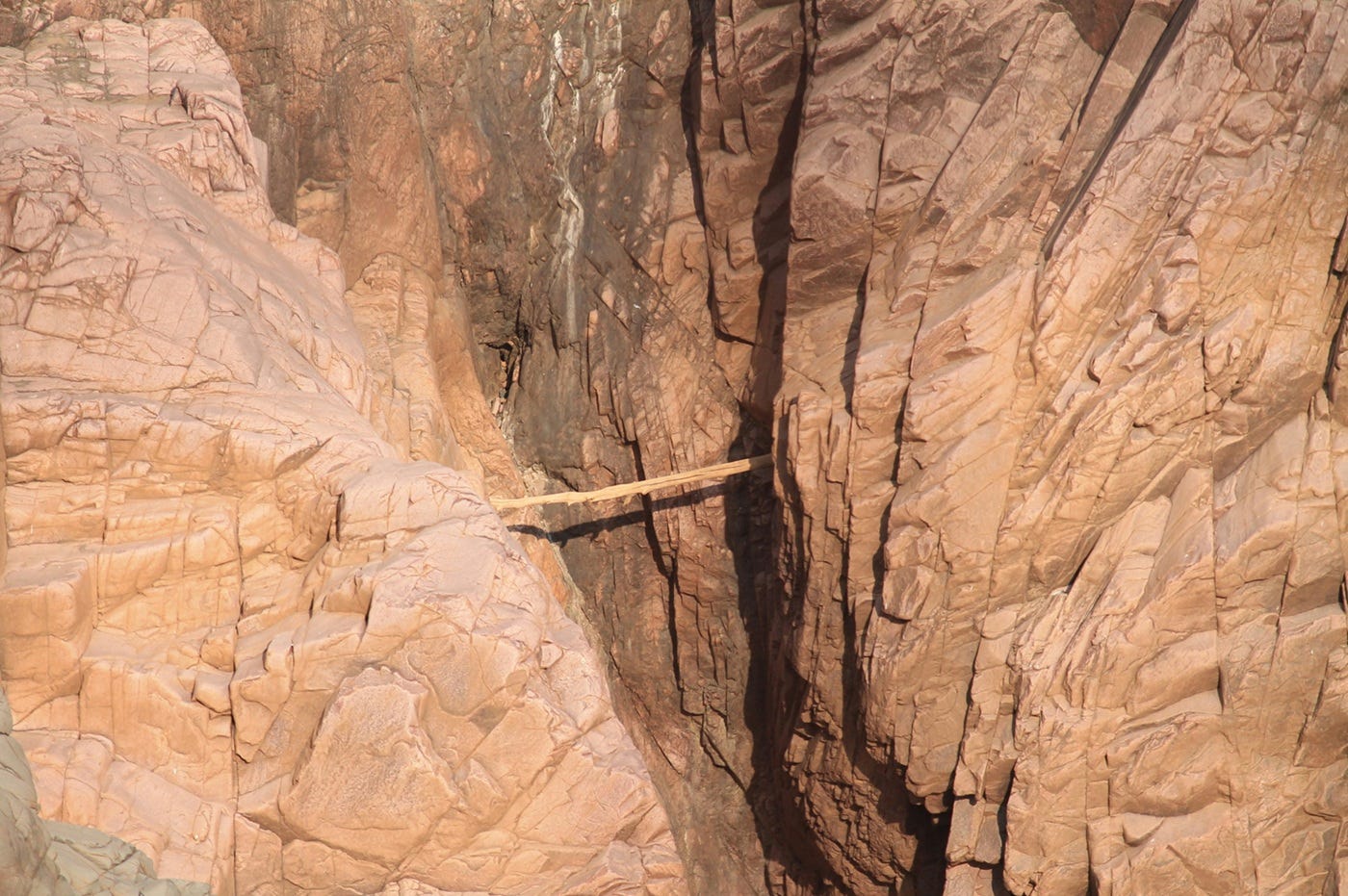
In the dream, I was on a long, thin log that connected two sides of a vast and deep canyon: Yes, I was on a narrow bridge. The ground lay thousands of feet below me and on the other side of the bridge was a place I knew to be “heaven.” I walked so carefully to get to the other side, towards the celestial light that awaited me, beckoning. But I faltered. Right in the middle of the bridge, teetering over the deepest, most treacherous part of the canyon, I lost my footing and almost fell to my death. I hung by my fingertips, my feet dangling in space above a terrifying chasm. But I didn’t fall. A wise, powerful force helped me back upright. And I felt so protected, so held, so supported. Although I didn’t make it to the other side in the dream, not yet, I awoke knowing that I would get there, eventually.
In honor of Rosh Hashanah, and Alan Lew, and my childhood dream, I wrote this poem about trying, failing, and trying again, striving to get back, to “return” to the divine—the miraculous source pulsing through all living things, an invisible string, tying us all together, bringing us closer to home.
Confession
As a child, I dreamt of you.
I dream of you now.

I saw you as a river
I saw you as a mountain
I saw you as the string on a guitar
I saw you as a single blade of grass
I saw you as the new moon
I saw you as a star

I watched you
on the bridge
You were too far
to reach.

I see you now.

Tip-toed
on a narrow plank
stretched like soft leather
across the canyon
I stumbled,
fumbled toward you:
Lumbering, longing, desperate.

Clumsy, half-drunk,
I grasped,
gasped to be near you:
Rich as pressed silk,
fine as herringbone,
redolent as rosewater.

Me, clawing back home,
skin raw as bone,
fingernails bleeding
from their seams,
bruises and scabs on my knees.

Alone.

Once, twice, a hundred times
I fell.
A thousand times at least:
I saw my body plunged below,
crashed slick against the rocks,
splayed
like sea-moss and salt-spritz
laid
on the cliffs.

I saw it. I see it now.

Saw my limbs burned to ash,
organs turned to embers.
Saw my whole world
pressed into a pebble
small enough to clasp
in my palm.
Saw the planets and comets
crumble
into chasms.
Saw myself plummet,
gobbled up
by the galaxies,
obliterated
into dust.
An entire life
left to rust.

Maybe ten thousand times:
I felt it all fall
away
beneath my feet.

And every time,
a hundred thousand times
at least:
I awoke
in a sweat
Like cold smoke
back up
on the bridge,
careened into the air
standing right there:
You.
Inevitable as the tides,
returning me.

I felt you: as an undertow,
heard you as an earthquake,
knew you as a fault line,
traced you with my hand,
caught you in my throat
like storm sand.

You were strong as steel
light as cellophane
weightless as wind

I feel you now.

A million times:
you’ve come.
Found me,
rescued me.
A hundred million times.
At least.
So much that
I grew angry
when you hid your face.

I cried out to you in every language.
I called you every name.
Allah, Adonai, Mother, Father.
You never answered to those words.
I learned those are not your names.
Yet, when I call you home, you get closer.
The ‘narrow bridge’ metaphor is originally attributed to a text by the Hasidic master Rabbi Nachman of Breslov
Famously, in the Torah portion Shemot, in the book of Exodus, God appears to Moses as a burning bush
Nefesh is a Hebrew word with many meanings. It can refer to a soul, it can refer to a nothingness. And it can also mean air or breath, or a vital spirit. Lots of interpretations. And I’m no expert!
Important to note that Lew wrote this book in 2003, long before the ubiquity of smart phones and social media with polarized algorithms. The societal problems he’s diagnosing here have only gotten precipitously worse in the decades since.
On the eve of the chronic sinusitis for which I am now being treated, I had a dream in which I received an ultimatum from my psyche/soul: Leave the perishable behind and take refuge in the imperishable.
The imperishable has no name, not even God. Zen calls this “no-mind.” It has no birth and therefore no death. It has no beginning or end. It is completely non-conceptual. Stop thinking about it, I was told. Just match it with what you call in your wonderful essay
“nothing.”
But remember the concept of “nothing” is not a substitute for it. I was told to learn to disappear; to go, as Lew Welch said, “out of my mind.” And, dau-dau, that ain’t easy. But neither you nor I have any choice in the matter. As long as we think we do, we’re like parachutes opened but caught uselessly in a tree.
This is so so so beautiful, yes! To the fertile void, Shana Tova!